Bowling Green: Hamilton Becomes an Artillery Captain (1776)
Bowling Green
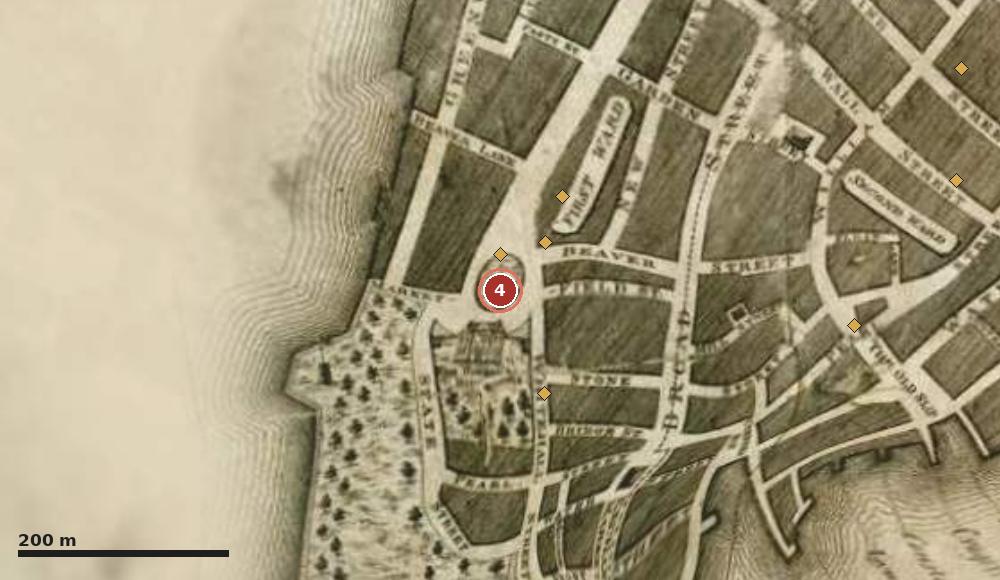
In Hamilton's day
In March 1776 Hamilton was commissioned captain of the New York Provincial Company of Artillery. On 9 July, after the Declaration of Independence was read to the army, a crowd pulled down the gilded statue of George III at Bowling Green.
By September the British held the city. They occupied it for seven years, and Hamilton went on to serve as Washington's aide-de-camp and to lead an assault at Yorktown in 1781.
Visiting today
Bowling Green, at the foot of Broadway, is the city's oldest public park. The iron fence around it dates from 1771; its crowns were sawn off in 1776.
Nearby in Hamilton's day
- No. 1 Broadway: British headquarters1776–83
The Kennedy mansion facing Bowling Green served as British headquarters during the occupation, home to Sir Henry Clinton, commander-in-chief from 1778 to 1782.
- Hamilton's home, 26 Broadwayto 1802
The family's last downtown house before the move to the Grange. Burr had lived at the same address in the early 1790s.
- Second Presidential Mansion1790
Washington moved to the Macomb house at 39 Broadway in February 1790.
- Fort Georgeto 1790
The British fort at the island's tip, torn down in 1790. The Custom House now stands on the site.
- The Independent Journal1787
Archibald McLean's newspaper in Hanover Square printed Federalist No. 1, Hamilton's opening essay, on 27 October 1787.
- The Exchange: first Supreme Court1790
The U.S. Supreme Court held its first session here at the foot of Broad Street in February 1790.