57 Wall Street: Hamilton's Home and Law Office
57 Wall Street (then No. 58)
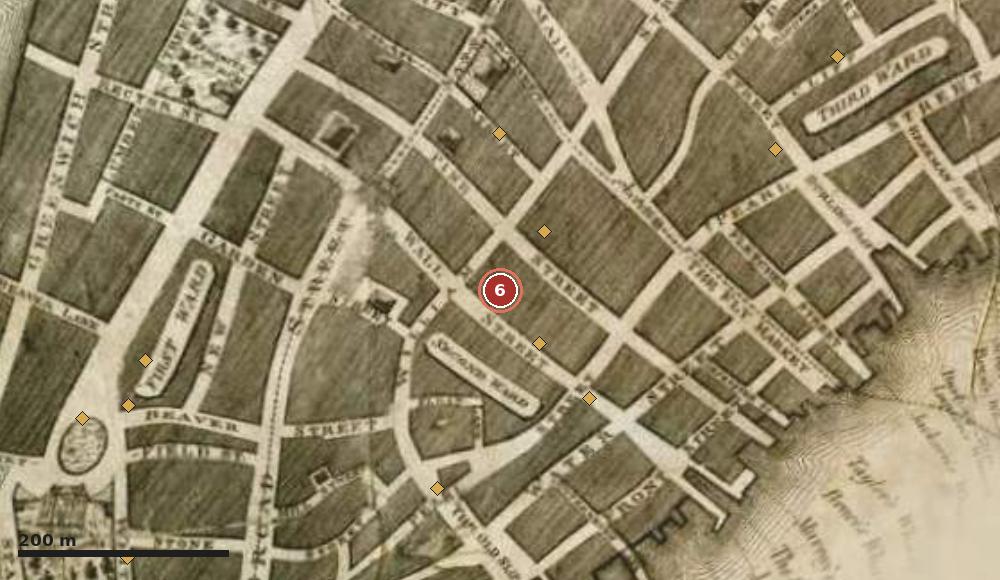
In Hamilton's day
The Hamiltons lived on Wall Street, with his law office in the house. In Rutgers v. Waddington (1784) he defended a Loyalist against a state law that conflicted with the peace treaty, an early argument for judicial review.
Here he wrote most of The Federalist, 51 of its 85 essays, published in New York newspapers in 1787 and 1788 to win ratification of the Constitution.
In the 1780s Wall Street was a residential street of merchants' and lawyers' townhouses. It took its name from the wooden wall the Dutch built in 1653 along the city's northern edge.
“I never expect to see a perfect work from imperfect man.”
The Federalist No. 85, 1788
Visiting today
57 Wall Street is a colonnaded 1840s building on the site. The house is gone. It is a two-minute walk from Federal Hall.
Nearby in Hamilton's day
- Buttonwood Agreement1792
Twenty-four brokers signed the pact that began the New York Stock Exchange, months after a financial panic Hamilton worked to calm.
- New-York Evening Post1801
Hamilton raised the money to found the Evening Post in 1801 as a Federalist newspaper. It still publishes today as the New York Post.
- Tontine Coffee House1793
Merchants' exchange at Wall and Water Streets where the young stock market traded.
- Livingston Sugar House prison1776
A sugar warehouse on Liberty Street where the British held captured American soldiers.
- The Independent Journal1787
Archibald McLean's newspaper in Hanover Square printed Federalist No. 1, Hamilton's opening essay, on 27 October 1787.
- Hercules Mulligan's shop1772
Tailor and Son of Liberty. Hamilton lodged with Mulligan when he first arrived; Mulligan later spied for Washington.